
Hello, everyone! Today, I’m excited to share a theme that is perfect for any season: “Rain.” While rain can sometimes be a gloomy day for adults, for our little learners, it is a fascinating world waiting to be explored. We spent the day diving into the science of weather, how animals stay dry, and our own feelings about rainy days.
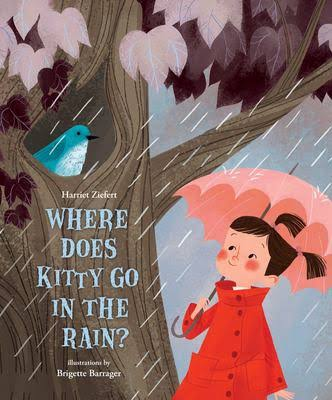
📚 Recommended Book: Where Does Kitty Go in the Rain?
To kick off our adventure, we read Where Does Kitty Go in the Rain?. This book is wonderful for building prediction skills as we guessed where Kitty would hide during the storm. Beyond the story, we used this as a starting point to explore nature—discussing how a duck’s feathers are waterproof, how squirrels use their bushy tails for shelter, and what kind of safe “shelter” Kitty might find.
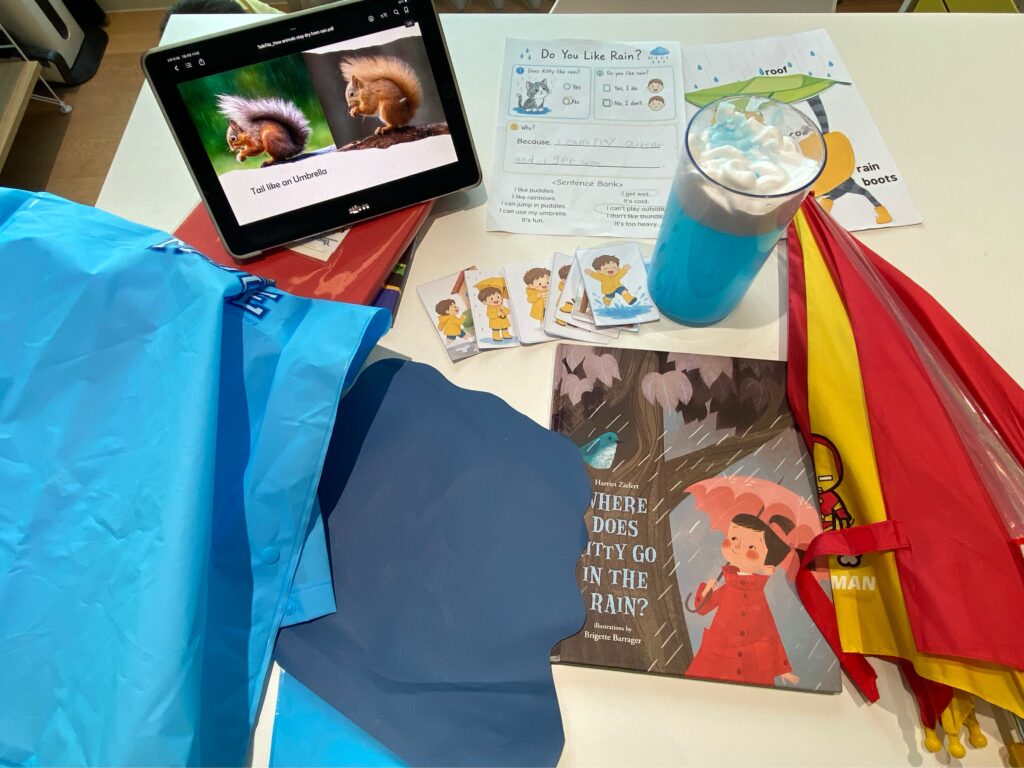
🎨 Today’s Activities: Bringing the Rain Indoors
We turned the concept of rain into a tangible, hands-on learning experience through various activities.
- Wet or Dry? Sensory Sorting: We started with a sensory play activity to distinguish between “wet” and “dry” items, which helped reinforce these important descriptive adjectives.
- Rainy Cloud Experiment: Using shaving cream and food-colored water droppers, we created our own “clouds”. Watching the “rain” fall when the cloud got “heavy” helped the children visually understand the basic concept of precipitation.
- Simon Says (Rainy Day Edition): We played a high-energy game of “Simon Says” to practice essential action verbs and clothing vocabulary. Phrases like “put on your raincoat,” “take off your rain boots,” and “open your umbrella” were repeated until the children were acting them out confidently.
- Journaling & Presentation: We wrapped up by writing a short journal entry answering, “Do you like rain?”. Using the sentence frames “I like rain because…” and “I don’t like rain because…”, the children practiced both writing and speaking to express their personal opinions.
💡 Teacher’s Tip: Expanding Vocabulary
When teaching about weather, try to move beyond single words like “cloud” or “rain.” Encourage your child to use comparative language (e.g., “heavy rain,” “light rain”). During the journaling portion, don’t just accept “I like rain.” Prompt them with “Why?” to help them build complex sentences using the conjunction “because.” This transition from simple words to full sentences is a major milestone in language development.
📝 Final Thoughts
It was truly rewarding to see the children connect the science of weather to the vocabulary we learned. By mixing sensory science, movement-based games, and reflective writing, the “Rain” theme became much more than a lesson—it was a full educational experience. I hope you’ll try these activities at home on the next rainy day!
Vocabulary & Key Phrases Covered:
- Vocabulary: cloud, heavy, rain, wet, dry, waterproof, shelter, hide, tail.
- Sentence Patterns: “Yes, I do / No, I don’t,” “I like rain because…,” “I don’t like rain because…”.